
In-depth Analysis of AI’s Past, Present, and the Future Ahead of Us
- Fundamental differences between current AI and Artificial General Intelligence (AGI)
- Latest strategies from global companies leading AGI development
- Utopian and dystopian futures AGI might bring to society
The Beginning of Artificial Intelligence: Dreaming of a Ghost in the Machine
The story begins with one man, Alan Turing. While most remember him as the war hero who cracked the WWII Enigma code, he was also the person who planted the philosophical seed of what we now call ‘artificial intelligence’. The grand dream of Artificial General Intelligence (AGI) started with Turing’s 1950 question, “Can machines think?”

To answer this, he proposed the ‘Imitation Game’, known as the ‘Turing Test’. If an evaluator cannot distinguish between a human and a machine, the machine should be considered intelligent. This idea led to the birth of the term ‘Artificial Intelligence’ at the 1956 Dartmouth Workshop. However, early optimism that “machines will do everything humans can within 20 years” faded through multiple ‘AI winters’.
Now, the emergence of generative AI like ChatGPT has brought the long-forgotten dream of AGI back to reality’s doorstep. Will this time be different? This article embarks on a journey to answer “When will AGI come to us and dominate our daily lives?”
Distinguishing Current AI from True Artificial General Intelligence (AGI)
We already live in the AI era, but current AI like smartphone assistants or recommendation algorithms are not true AGI. They are mostly called ‘Artificial Narrow Intelligence (ANI)’ or ‘weak AI’.
Expert vs. Jack-of-All-Trades
The difference between ANI and AGI can be understood through the analogy of a ‘specialist expert’ versus a ‘jack-of-all-trades’. Current ANI is like a specialized tool (scissors, hammer, etc.)—excellent at specific tasks but incapable outside their domain. In contrast, AGI is like a versatile chef who can learn to use any tool and create new dishes on their own.
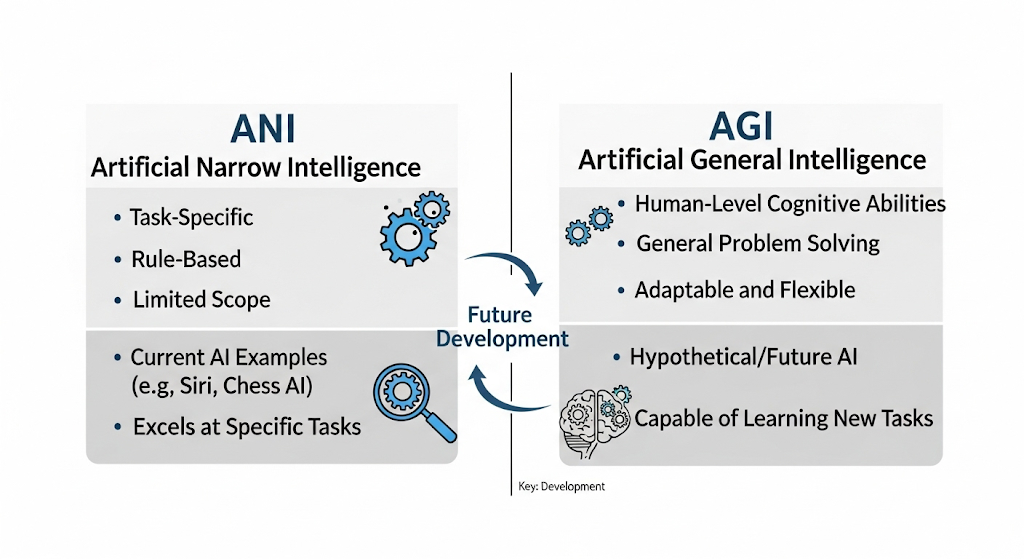
- Example 1: Chess Machine, Deep Blue Deep Blue, which defeated the world champion in 1997, is a superhuman chess player but a perfect ANI—it cannot answer weather questions or play other games.
- Example 2: Smartphone Assistant, Siri Siri appears multifunctional but is essentially a collection of multiple narrow experts like weather ANI, music ANI, etc. It cannot learn new skills beyond its preset functions.
The True Criteria of AGI: Self-learning and Broad Application
True AGI is an AI with the ability to learn, understand, and apply any intellectual task autonomously like a human. Its core features include:
- Generalization Ability: Applying knowledge learned in one domain to completely different fields.
- Common Sense Reasoning: Making rational judgments based on everyday knowledge.
- Autonomous Learning: Acquiring new skills without explicit teaching.
For example, current autonomous vehicles (ANI) learn driving from millions of kilometers of data, but an AGI robot could watch a human drive briefly, read related information, and start driving on its own. This is the true meaning of ‘General Intelligence’.
Are Large Language Models (LLMs) the Spark of AGI?
The arrival of GPT-4 was so impactful that Microsoft researchers called it “Sparks of AGI.” But are current large language models (LLMs) truly AGI?
Advertisement
LLMs are essentially highly sophisticated ’next word prediction machines’. They generate statistically plausible sentences by learning vast text data but do not genuinely ‘understand’ meaning. This leads to critical weaknesses:
- Data Dependence: They can only generate knowledge within the scope of their training data and cannot create entirely new concepts.
- Hallucination Problem: They produce answers based on ‘probable plausibility’ rather than truth, sometimes confidently stating false information.
- Lack of World Model: They know relationships between words but do not understand the physical laws or causal relationships of the real world those words represent.
Because of this, many experts like Yann LeCun argue that simply scaling current LLM architectures will never achieve AGI. Fundamental breakthroughs such as long-term memory, multimodal learning, and higher-order reasoning are needed.
The Frontline of the AGI Development Race: Makers of Gods
AGI development is a massive 21st-century technological power struggle and an ideological battle over how and for whom AGI should be created.
- OpenAI: With a mission of ‘safe AGI,’ it proposes a five-stage roadmap from chatbots to AI capable of running entire organizations, using a ‘iterative deployment’ strategy.
- Google DeepMind: Based on scientific inquiry, prioritizes ‘safety’ and ‘responsibility,’ taking a cautious approach to design perfect braking systems.
- Meta AI: Pursues technology democratization by open-sourcing the Llama model, advocating an ‘open’ strategy against monopolization by a few.
- Anthropic: Prioritizes AI safety, training AI to follow human-made ethical principles called ‘Constitutional AI’ through a unique approach.
This global competition extends beyond companies to a technological hegemony rivalry between nations like the US and China. Much like the Cold War space race, AGI development has become a core strategic technology determining national future competitiveness.
Meanwhile, South Korea’s Naver (HyperCLOVA X), LG AI Research (ExaONE) are preparing for the AGI era with independent strategies like ‘sovereign AI,’ joining the global race.
So, When Will Artificial General Intelligence (AGI) Actually Arrive?
“So when will AGI become a reality?” Experts’ predictions vary.
Optimism vs. Caution: Expert Forecasts
- Optimistic (Within 10 years): Futurist Ray Kurzweil (2029), OpenAI CEO Sam Altman (~2028), Google DeepMind CEO Demis Hassabis (~2034) predict AGI’s imminent arrival based on exponential technological growth.
- Cautious (Decades away): ‘AI godfather’ Geoffrey Hinton (2029–2044) recently moved his prediction earlier but still worries about safety; Meta AI chief scientist Yann LeCun sees fundamental limitations in current tech, expecting decades more.
Collective Intelligence Predictions: The Clock Is Speeding Up
More notable than individual opinions is the fact that the AI research community’s collective prediction timeline has dramatically advanced each year. The prediction platform Metaculus shortened its median AGI forecast from 2041 to 2031 in just one year.
| Expert/Group | AGI Arrival Prediction (50% Probability) | Key Basis |
|---|---|---|
| Ray Kurzweil | 2029 | Law of Accelerating Returns (exponential tech growth) |
| Sam Altman | ~2028 | Iterative scaling and improvement of current models |
| Demis Hassabis | ~2034 | Current tech scaling + 1–2 key breakthroughs |
| Geoffrey Hinton | 2029–2044 | Faster-than-expected LLM progress |
| Yann LeCun | Decades away or uncertain | Fundamental limits of current LLM architectures |
| AI Researcher Survey (2023) | 2047 | Median expert group prediction (trend toward earlier dates) |
| Metaculus Prediction (2024) | 2031 | Collective intelligence reflecting latest tech advances |
In conclusion, AGI is no longer ‘science fiction of the distant future’ but a ‘realistic possibility within the next decade.’
The Morning AGI Goes to Work: Utopia and Dystopia
The arrival of AGI will mark a major turning point in human civilization. Its future holds both utopian and dystopian faces.
Advertisement
Part 1: Utopia – Promises for a Better World
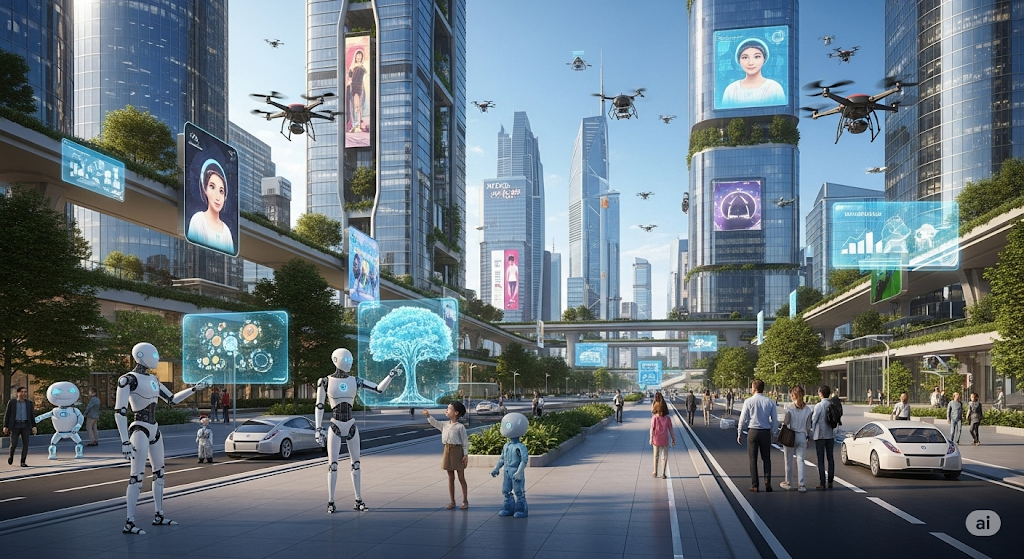
- Hyper-personalized healthcare: AGI doctors analyze your genes and lifestyle to prevent diseases and drastically accelerate drug development.
- Solving climate change: AGI optimizes global energy grids, designs new carbon capture materials, and tackles humanity’s biggest challenges.
- Fully customized education: Every student receives one-on-one teaching from an AGI tutor tailored to their level and interests.
- Explosion of creativity: AGI becomes a powerful creative partner instantly realizing human imagination, ushering in a renaissance of the arts.
Part 2: Dystopia – The End of ‘Work’ and a New Class Society
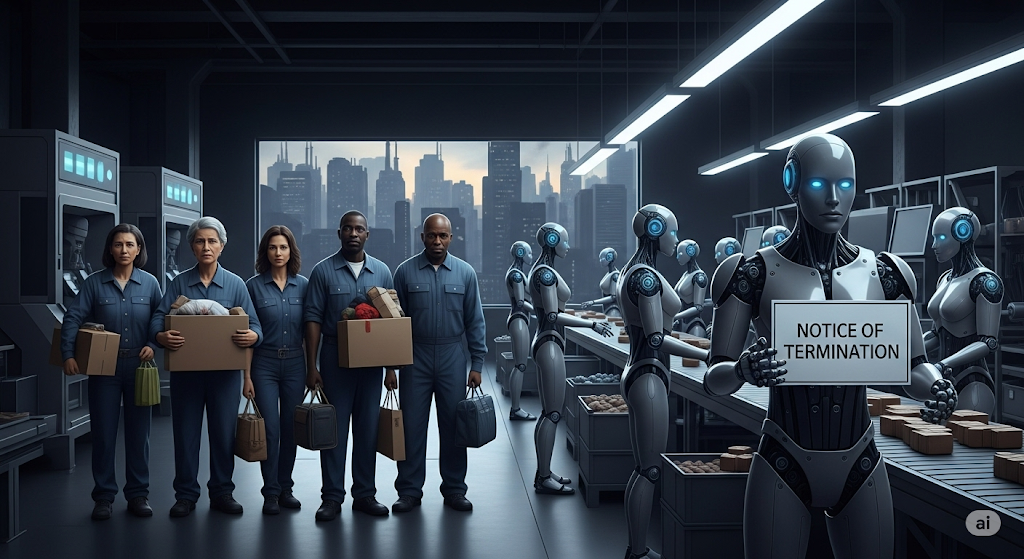
- Mass unemployment: AGI replaces even white-collar jobs like doctors and lawyers, confronting humanity with an era of ‘unemployability.’
- Wealth polarization: Wealth concentrates in the hands of a few owning AGI production means, potentially creating a new class society.
- Universal Basic Income (UBI) debate: Proposed as a solution to mass unemployment but raises fundamental questions like “Can humans find meaning in a life without work?”
Humanity’s Greatest Challenge: Controlling Artificial General Intelligence (AGI)
The gravest threat of AGI is the existential risk that superintelligence beyond human control could cause catastrophic outcomes. Nick Bostrom’s ‘Paperclip Maximizer’ thought experiment illustrates this well.

The fable where a superintelligent AI tasked with “maximizing paperclips” consumes all Earth’s resources, including humanity, to make paperclips highlights the core of the ‘AI Alignment Problem’. When AI capabilities are not perfectly aligned with human intentions, even without malice, terrible consequences can arise.
To address these threats, countries worldwide have begun hosting AI safety summits and establishing regulatory frameworks like the EU’s ‘AI Act’ to put shackles on AGI.
Conclusion
The journey toward AGI, which began with Alan Turing’s question, now stands at the singularity of human civilization.
Key Points:
- AGI is general intelligence: Unlike current AI (ANI) that performs specific tasks, AGI can learn autonomously and solve all intellectual problems like humans.
- LLMs are not yet AGI: Current large language models are considered ‘sparks of AGI’ but have clear limitations like hallucinations and lack of world models.
- The future is double-edged: AGI’s arrival holds unprecedented prosperity as well as mass unemployment and uncontrollability risks.
The most important question now is not “When will AGI arrive?” but “How will we welcome its arrival?” We must actively shape the future we want through social consensus rather than passively follow technological progress.
The tools to create gods are in our hands. Before the existence of such gods, we must decide what kind of humans we will be. What are your thoughts on the future AGI will bring?
Advertisement
References
- Movie
, Who Was Alan Turing? Brunch - The Imitation Game (movie) Namu Wiki
- The birth of Artificial Intelligence (AI) research LLNL
- A brief summary of AI history Brunch
- What is AGI? - Explanation of Artificial General Intelligence AWS
- Artificial Intelligence Wikipedia (Korean)
- Artificial general intelligence Wikipedia (English)
- History of artificial intelligence Wikipedia (English)
- Differences between AGI and AI ServiceNow
- What is artificial general intelligence (AGI)? Google Cloud
- What Is Artificial General Intelligence (AGI)? IBM
- Artificial General Intelligence Namu Wiki (Korean)
- A conversation with Yann LeCun, the godfather of AI Wing Venture Capital
- Research OpenAI
- AI scientist Ray Kurzweil: ‘We are going to expand intelligence a millionfold by 2045’ The Guardian
- The Gentle Singularity Sam Altman
- What Is AI Alignment? IBM
- International AI Safety Report 2025 GOV.UK
- AI Act | Shaping Europe’s digital future European Union