
Beyond a simple history of hygiene, a dynamic drama shaped by religion, philosophy, and the everyday lives of ordinary people.
- Understand how Korean bathing culture has changed through different eras.
- Grasp the social and philosophical shifts embedded in the act of bathing.
- Discover the deep historical roots of the jjimjilbang culture we enjoy today.
Questions Arising from the Jjimjilbang
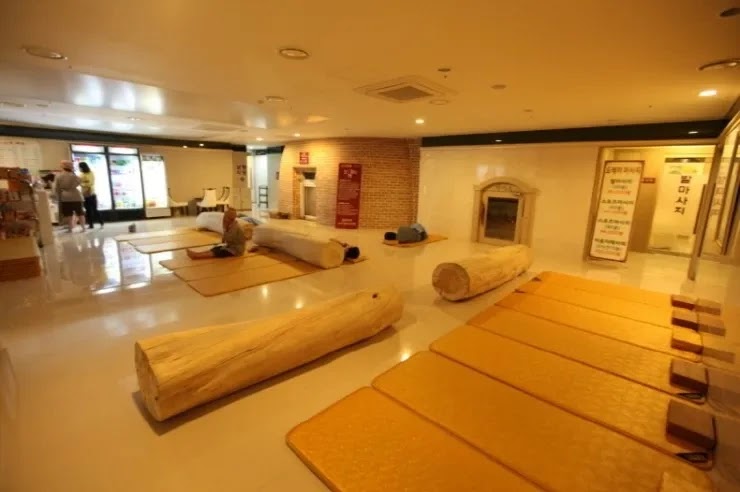
A steamy space filled with the sound of flowing water from all directions, the sweet scent of maekbanseok eggs and icy sikhye. Today, jjimjilbangs are more than just places to wash—they are unique cultural complexes encompassing rest, socializing, and entertainment.
But have you ever wondered? Since when have we bathed like this? Where did this distinctive Korean bathing culture, with its refreshing scrubbing and soaking in hot water, originate?
This article embarks on a long journey tracing the tumultuous path of Korean bathing culture—from sacred rituals to luxurious hobbies, through ideological suppression, and finally to a vibrant modern revival.
Part 1. Sacred Water: Washing the Body to Build a Nation (Three Kingdoms Period)
Surprisingly, Korean bathing history begins not with ‘cleanliness’ but with ‘holiness.’ It is rooted not in hygiene but in grand myths that prove the birth of the nation and the sanctity of kings.
Bathing in Myth: The Purification Ritual That Gave Birth to Kings
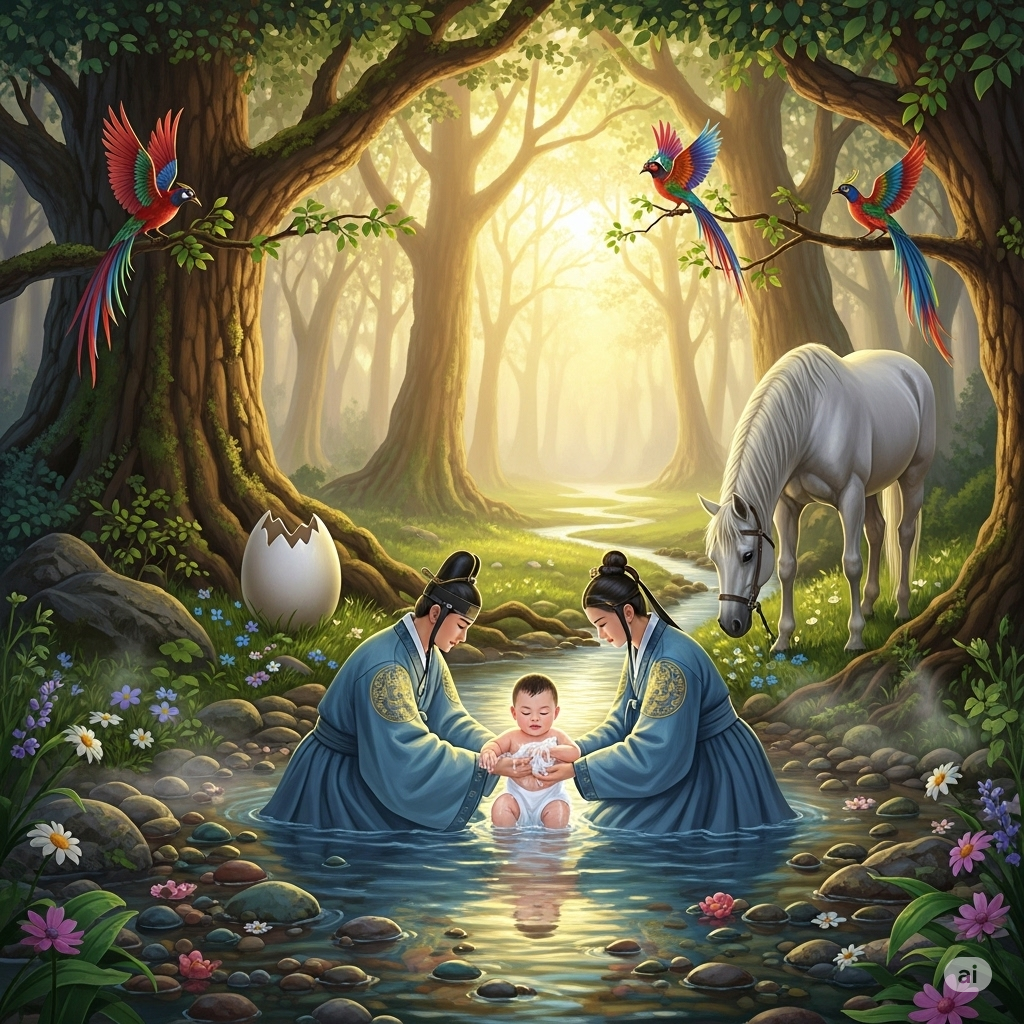
The oldest bathing record tells the story of Park Hyeokgeose, the founder of Silla, and Queen Alyeong. According to the “Samguk Yusa,” when the newborn Park Hyeokgeose was bathed in the East Spring, his body radiated light. Bathing was the first gateway transforming an ordinary baby into a sacred being.
Queen Alyeong’s story is even more dramatic. Born with a chicken’s beak, she bathed in the North River, and the beak fell off, revealing her perfect beauty. This symbolizes that bathing held the transformative power to turn imperfection into perfection and rebirth humans as sacred beings.
Buddhism Brings Bathing into Daily Life
The primal reverence for water became a systematic religious practice with the introduction of Buddhism. Before ceremonies or prayers, cleansing the body—‘Mokyokjaegae (沐浴齋戒)’—was an important precept.
Thanks to this religious duty, Silla people bathed more frequently. Temples installed large public baths for worshippers—the first public bathing facilities in Korean history. Bathing thus became an accessible part of faith for commoners, and this developed culture even spread to Japan.
Part 2. Aesthetic Water: Pursuing Beauty (Goryeo Dynasty)
The religious bathing culture of Silla reached an unprecedented golden age during the Goryeo period. The sacred purification ritual evolved into a secular and aesthetic culture focused on beauty and pleasure.
Advertisement
“Goryeo People Bathe Three Times a Day”: The Golden Age of Bathing
In the 12th century, Song Dynasty envoy Seo Geung marveled in the “Goryeo Dogyeong” that “Goryeo people bathed three times a day.” This shows that bathing was a source of pride and an everyday routine for Goryeo people.
Most intriguingly, he noted that men and women bathed together in a large stream near the capital Gaeseong. This practice called ‘mixed bathing (혼욕)’ suggests that Goryeo society’s attitude toward the body was far more open than in later periods.
Investing in Beauty: Orchid Baths and Natural Soaps
Bathing in Goryeo went beyond cleanliness to become an elaborate beauty ritual.
- The pinnacle of skincare, Orchid Bath (Nantang): The upper class enjoyed bathing in water boiled with orchids to whiten and soften skin. Other ingredients included ginseng leaf decoctions (Samtang) and peach blossom water.
- Natural cleanser ‘Jodu (조두)’: Powder made from ground red beans or mung beans was used like soap to effectively remove grime.
As bathing culture flourished, the elite even had separate bathing rooms called ‘Jeongbang (淨房)’ in their homes. However, this aesthetic culture later became a target of criticism by Confucian scholars advocating strict asceticism.
Part 3. Concealed Water: Trapped by Etiquette (Joseon Dynasty)
The free-spirited bathing culture of Goryeo sharply declined with the founding of the Joseon dynasty. As the state ideology shifted to Neo-Confucianism, exposing the naked body became one of the greatest taboos.
Is Undressing a Sin? The Era of Partial Bathing
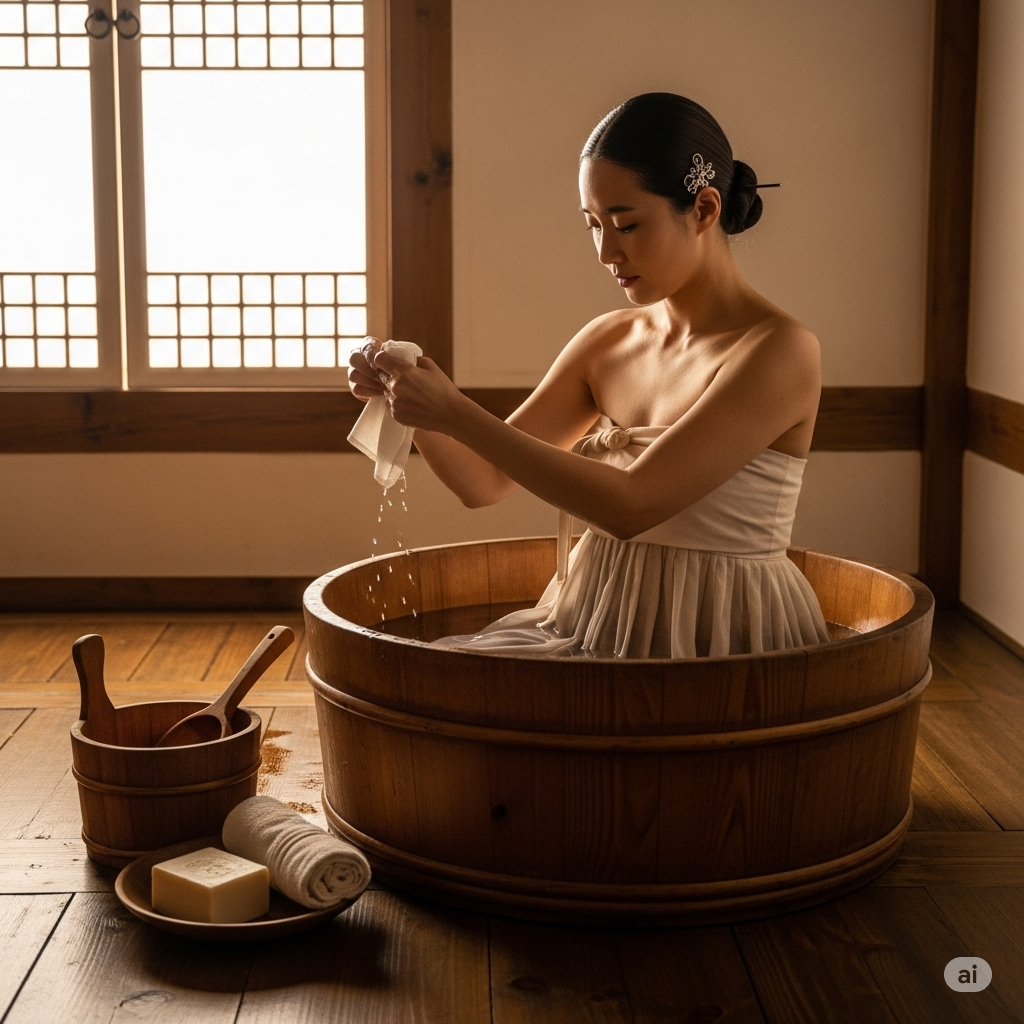
In Joseon society, undressing was considered rude and against etiquette. Full-body immersion became rare, replaced by ‘partial bathing (부분욕),’ washing only parts of the body.
People stood clothed beside the traditional ‘Hamjibak’ basin and poured water over themselves with a small dipper. This symbolically reflects the era’s obsession with concealing the body.
The King’s Exception: Hot Spring Trips for Healing
Ironically, the king bathed most frequently, but only under the justification of ’treatment.’
King Sejong, who suffered many illnesses, made numerous royal trips to hot springs across the country such as Onyang and Icheon. These were desperate medical acts to restore the king’s health.
Advertisement
Bathing Survives in Folk Customs: Dano and Yudu
Despite official ideological repression, ancient folk beliefs persisted.
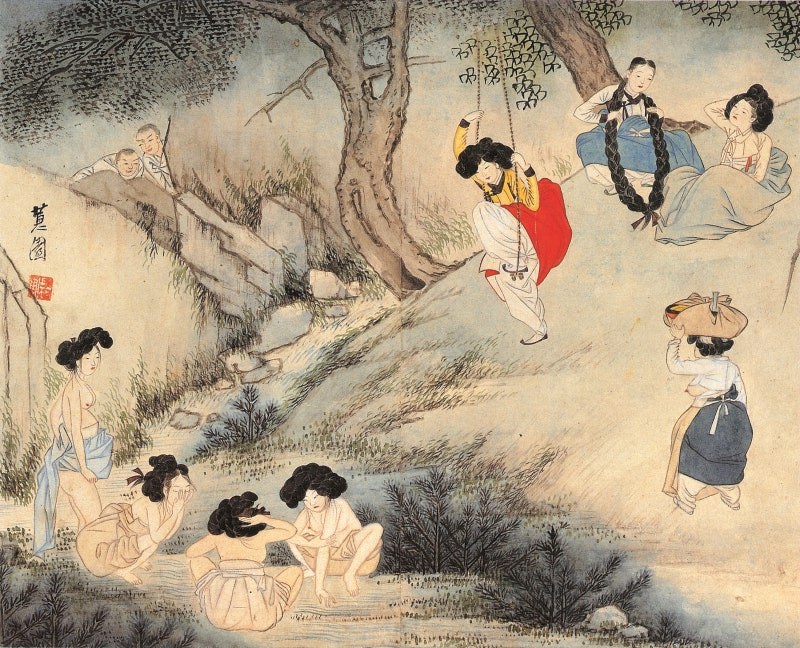
- Dano Festival and Changpo (Sweet Flag): On the 5th day of the 5th lunar month, women washed their hair with water boiled with changpo. This had both beauty benefits and a ritual to ward off evil spirits.
- Yudu Festival and Dongryusu: On the 15th day of the 6th lunar month, people bathed in streams flowing eastward to prevent summer illnesses and wash away bad luck.
Part 4. Public Water: Reuniting with the Body, The Era of Public Baths (Modern Era)
The centuries-long era of private bathing ended in the early 20th century with Korea’s opening to the world. With the introduction of the new value of ‘hygiene’ from the West, the modern space of ‘public bathhouses’ emerged.
Birth of the Bathhouse and the Rise of the “Ttaemiri” (Body Scrubber)
In 1924, the first modern public bathhouse opened in Pyongyang. After liberation, urbanization and industrialization popularized public baths. Since most homes lacked bathing facilities, local bathhouses became essential community hubs.
Within this new space, a uniquely Korean bathing culture emerged: the professional ’ttaemiri’ scrubbing service. The occupation now called ‘Sesinsa (洗身士)’ likely appeared around the 1970s. Scrubbing off dead skin became more than exfoliation—it became a ritual of shedding the old and feeling refreshed.
Comparison of Korean Bathing Culture by Era
A glance at the long history of Korean bathing culture highlights its distinctive features.
| Era | Core Purpose | Key Features |
|---|---|---|
| Three Kingdoms | Religious purification | Proving king’s sanctity, temple-centered bathing rituals |
| Goryeo | Beauty, socializing | Mixed bathing, orchid baths (nantang), aesthetic focus |
| Joseon | Taboo, healing | Confucian repression (partial bathing), royal hot springs, folk customs |
| Modern | Hygiene, leisure | Emergence of public baths, ttaemiri culture, jjimjilbang development |
Conclusion: Jjimjilbang, a New Icon of K-Culture
The long journey of Korean bathing culture culminates today in the unique space of the ‘jjimjilbang.’ Jjimjilbangs are the ultimate synthesis of past bathing cultures, reborn in a modern form.
The various themed jjimjilbangs recall the Joseon royal tradition of therapeutic hot springs, while their restaurants and entertainment areas evoke the social culture of Goryeo. This unique culture is now recognized as a global icon of K-culture.
Looking back, Korean bathing culture seems to have cycled from Goryeo’s “open bathing” with community, through Joseon’s “closed bathing” under Confucian order, and back to a new form of “open bathing” in jjimjilbangs. My own experience of jjimjilbangs was not just about cleansing the body but a precious space to bond freely with family and friends.
Key Takeaways
Advertisement
- From Holiness to Leisure: Korean bathing evolved from sacred purification to beauty, healing, hygiene, and today’s complex leisure culture.
- Mirror of the Times: Changes in bathing reflect dominant ideologies and social conditions like Buddhism and Confucianism.
- Cultural Fusion in Jjimjilbang: Modern jjimjilbangs embody historical codes from Silla’s purification, Goryeo’s socializing, Joseon’s healing, and modern hygiene.
As apartment living becomes widespread and old neighborhood bathhouses disappear, the tradition continues in the form of jjimjilbangs. Next time you visit one, why not reflect on this grand chronicle of water and body? The familiar space might feel entirely new.
References
- Bathing (沐浴) Encyclopedia of Korean Culture
- How Did We Bathe? National Folk Museum of Korea
- Immersed in Bathhouse Culture Reflected in Overseas Media Policy Briefing
- Bathing, Embracing the Hidden History Aladin
- Why Do Korean Bathhouses Scrub So Hard? JoongAng Ilbo
- [Annals of King Sejong and Royal Medicine] Kings’ Hot Spring Baths and Eye Disease Market Economy
- Where Did All the Bathhouses Go? Hankyoreh
- Bathhouses: From Entertainment to Hygiene to Cultural Spaces! Seoul Archives