
For years, a homeowner has poured affection into their house and finally decided to sell it. Even after hearing an objective market value appraisal from a real estate agent, they shake their head. They firmly believe their home is worth much more. Meanwhile, a potential buyer thinks the asking price is outrageously high. This gap goes beyond a simple difference of opinion. It stems from a powerful cognitive bias deeply embedded in human decision-making: the Endowment Effect.
The endowment effect refers to the psychological tendency to value an object more highly simply because one owns it, compared to when one does not.
This phenomenon directly contradicts the traditional economic model of the rational economic man (Homo Economicus), which assumes humans always act based on rational calculations. Why does the value of the same object change so asymmetrically based solely on ownership? This question opened the door to behavioral economics.
This article embarks on a journey exploring this fascinating psychological phenomenon, the endowment effect. Part 1 examines how the endowment effect was discovered and scientifically proven, especially through the landmark “Mug Experiment.” Part 2 analyzes the core psychological mechanisms behind the endowment effect, including Prospect Theory, Loss Aversion, Psychological Ownership, and Status Quo Bias. Part 3 looks beyond theory to concrete examples of how the endowment effect manifests in marketing, finance, and real estate. Finally, Part 4 offers practical suggestions for individuals to overcome this bias and for companies to strategically leverage it.
Part 1: Discovery and Proof of the Endowment Effect
1.1. Dawn of Behavioral Economics: Richard Thaler’s Insight
In 1980, economist Richard Thaler introduced the term “endowment effect” while explaining human irrationality in decision-making.
He found that people tend to underestimate the opportunity cost of alternatives they must give up. Simultaneously, once an object becomes their endowment, they assign it a much higher value than when they do not own it, showing a strong inertia to maintain the status quo.
Thaler’s insight provided a scientific framework to Aristotle’s vague intuition that “most things are valued differently by those who have them and those who want them. What belongs to us and what we give up always seems very precious to us.”
This discovery supported the core premise of behavioral economics: human choices are not always the result of rational utility maximization but are heavily influenced by psychological factors.
1.2. Landmark Experiment: Cornell University’s Mug Experiment
The clearest and most dramatic proof of the endowment effect came from the 1990 Mug Experiment conducted at Cornell University by future Nobel laureate Daniel Kahneman, along with Jack Knetsch and Richard Thaler.
This experiment clearly demonstrated how mere ownership drastically affects value assessment.
Advertisement
[Diagram] Mug Experiment Procedure Flowchart

The procedure was systematically designed as follows:
- Participant Recruitment and Random Assignment: Students in an economics class at Cornell were randomly divided into two groups. One group (sellers) received a Cornell-logo mug, sold at $6 in the campus bookstore, as a gift. The other group (buyers) received nothing.
- Value Assessment: Sellers were asked the minimum price they would accept to sell their mug (Willingness to Accept, WTA). Buyers were asked the maximum price they were willing to pay for the same mug (Willingness to Pay, WTP).
- Market Formation and Trading: After collecting prices from all participants, researchers determined a market price where supply met demand and announced that actual cash transactions would occur at that price. This process was repeated several times to allow participants to learn the market mechanism.

The results completely overturned traditional economic predictions. According to theory, since mugs were randomly assigned, about 50% of the mugs should have been traded in an efficient market. However, actual trades were far fewer: 4, 1, 2, and 2 mugs in four market rounds respectively.
The low trading volume was due to a significant difference in value assigned by sellers and buyers.
[Graph] Comparison of WTA and WTP in the Mug Experiment

The median WTA among sellers was about $5.25, while the median WTP among buyers ranged between $2.25 and $2.75. Simply owning the mug for a few minutes caused sellers to value it more than twice as much as non-owners.
1.3. The WTA-WTP Gap: The Price Abyss Created by Ownership
The dramatic gap between Willingness to Pay (WTP) and Willingness to Accept (WTA) in the mug experiment is core evidence of the endowment effect. Traditional economics holds that value is determined by individual preferences and ownership should not affect valuation; thus, WTP and WTA should be nearly equal.
Advertisement
However, the endowment effect directly contradicts this. The WTA-WTP gap has been consistently observed across various goods and contexts. For example, owners’ WTA for NCAA basketball final tickets was 14 times higher than non-owners’ WTP.
Other studies reported large WTA-WTP gaps for lotteries, chocolates, wine, and even public goods like air quality improvements and food safety.
[Table] Comparison of WTA/WTP Ratios in Major Endowment Effect Experiments
| Good | WTA/WTP Ratio |
|---|---|
| Cornell Mug | About 2.0 |
| NCAA Final Tickets | About 14.0 |
| Lottery | About 4.0 |
| Air Quality Improvement (Public Good) | About 7.0 |
| Non-fungible Goods | High |
Academic Debate: Fundamental Bias or Experimental Artifact?
While the endowment effect is widely accepted as a strong and universal phenomenon, not all scholars agree. Researchers like Charles Plott and Kathryn Zeiler argued that the WTA-WTP gap may not stem from fundamental human preferences like loss aversion but from participant misunderstandings of the experimental procedures, producing an artifact.
They reported that when participants received thorough training on incentive-compatible mechanisms and anonymity was ensured, the WTA-WTP gap in the mug experiment was not statistically significant.
This critique refined understanding of the endowment effect, suggesting it is not an absolute law but highly dependent on context. The key question shifted from “Does the endowment effect exist?” to “Under what conditions does it appear strongly, weaken, or disappear?”
Part 2: Psychological Mechanisms Behind the Endowment Effect
Several fundamental psychological principles govern human decision-making behind the endowment effect. Understanding these offers deep insight into why “what’s mine” feels so special.
2.1. Core Theory: Prospect Theory and Loss Aversion
The most dominant and powerful theoretical framework explaining the endowment effect is Prospect Theory, proposed by Daniel Kahneman and Amos Tversky in 1979. This groundbreaking theory, which systematically explained human irrational choices, earned Kahneman the 2002 Nobel Prize in Economics.
Prospect Theory explains human value assessment through three key features:
- Reference Dependence: People evaluate situations not by absolute wealth but by changes relative to a specific reference point—gains and losses. In the endowment effect, this reference point is the current state of ownership.
- Diminishing Sensitivity: Sensitivity to gains or losses decreases as their magnitude increases.
- Loss Aversion: The most crucial concept, people feel the pain of losses much more intensely than the pleasure of equivalent gains. Studies show loss pain is about 1.5 to 2.5 times stronger than gain pleasure. The phrase “Losses loom larger than gains” succinctly captures this.
[Graph] S-shaped Value Function of Prospect Theory
Advertisement
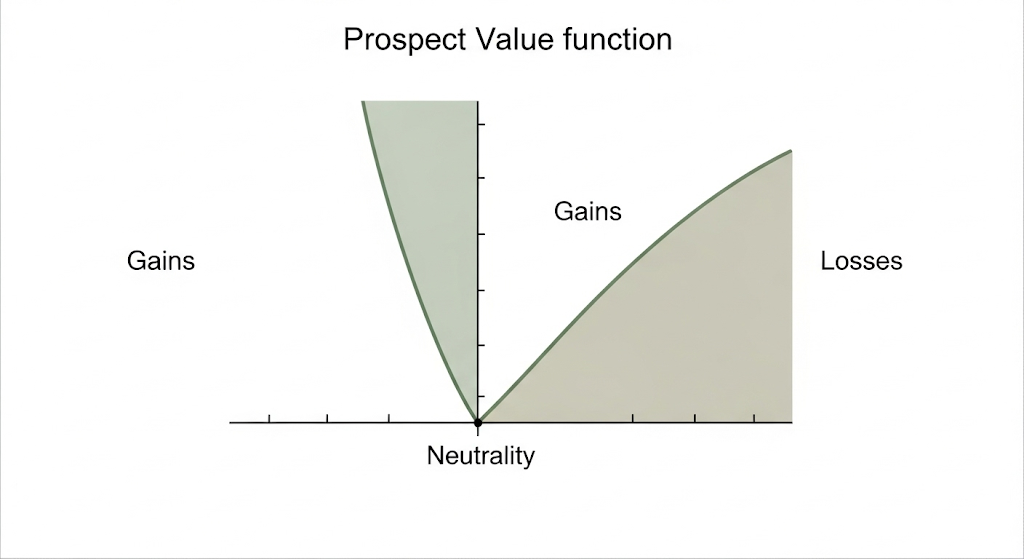
Applied to the mug experiment, the act of selling the mug is perceived by owners as a loss relative to their reference point (ownership), while buying the mug is a gain for non-owners. Due to loss aversion, sellers demand compensation (WTA) that exceeds buyers’ willingness to pay.
[Diagram] Pain of Loss vs. Pleasure of Gain

2.2. Psychological Ownership: The Power of Feeling “Mine”
Loss aversion explains why people dislike selling owned items but doesn’t fully answer why losing them is so painful. The concept of Psychological Ownership fills this gap. Separate from legal ownership, it is the subjective feeling that something is “mine.” The stronger this feeling, the more the object is seen as part of the self—an extended self.
Researchers identify three main pathways to develop psychological ownership:
[Diagram] Three Pathways to Psychological Ownership

- Control: Feeling able to influence and control the object.
- Intimate Knowing: Deep familiarity and knowledge of the object.
- Self-Investment: Investing time, effort, ideas, or money into the object.
This concept deepens understanding of the endowment effect: it’s not just possession but the emotional bond formed through interaction and investment that amplifies value. Selling the object is perceived as losing a part of oneself, intensifying the pain of loss.
2.3. Status Quo Bias: The Inertia of Resistance to Change
People tend to maintain the current state unless strong evidence suggests a better alternative. This is called Status Quo Bias, a sister bias closely linked to the endowment effect, causing irrational resistance to change.
Advertisement
Status quo bias is reinforced by loss aversion. Since the current state is the reference point, any change is perceived as a potential loss. Unless the potential gains from change overwhelmingly exceed the risks of loss, people prefer to do nothing.
[Infographic] Vicious Cycle of Status Quo Bias
- Inputs: Loss aversion, regret avoidance, decision paralysis, mere exposure effect.
- Process: Current state is seen as safe and superior reference; change is risky and uncertain.
- Output: Decision to reject change and maintain status quo, which further strengthens attachment and perpetuates bias.
Loss aversion, psychological ownership, and status quo bias intertwine to create the powerful psychological phenomenon of the endowment effect. Understanding these mechanisms is essential for analyzing real-world cases in the next section.
Part 3: The Endowment Effect in the Real World
The endowment effect is not confined to laboratory mugs. This powerful cognitive bias deeply influences decision-making in marketing, finance, real estate, and nearly every aspect of life.
3.1. Marketing Strategy: Stimulate the Sense of Ownership
Modern marketing has evolved beyond selling products to selling the experience of ownership. Companies employ various strategies to foster psychological ownership before purchase.
Case Study 1: The Power of Free Trials – Netflix, Wavve

OTT platforms like Netflix and Wavve offer one-month free trials as a classic endowment effect marketing strategy. During the trial, users explore content tailored to their tastes, create “My List” (self-investment), and become familiar with the interface and recommendation algorithms (intimate knowing).
After a month, the service is no longer a foreign platform but part of their daily entertainment routine. Canceling subscription feels like losing the convenient, personalized environment they invested time and effort in. Loss aversion kicks in, leading many to continue with paid subscriptions.
Case Study 2: Touch, Experience, Own – Apple, Tesla

Apple pioneered the experiential showroom strategy, allowing customers to freely handle and test products. Customers physically interact with iPhones and MacBooks (control), becoming familiar with their smooth operation and design (intimate knowing). This builds strong psychological ownership before purchase.
Advertisement
Tesla maximizes the endowment effect by letting customers customize every detail of their cars online—color, wheels, interior, autonomous options—designing “their own car.” This grants strong control and self-investment, fostering attachment even before production. Customers tend to maintain orders despite long waits, nurturing personal ownership.
3.2. Financial Investment: Why Is It Hard to Sell Losing Stocks?
The financial market is a prime stage where the endowment effect and loss aversion directly impact wealth. Investors often sell winning stocks too quickly but hold onto losing stocks, a behavior known as the Disposition Effect.
At the core is the endowment effect. Selling a losing stock means realizing a loss, a painful experience. Prospect Theory shows this pain outweighs the joy of equivalent gains. To avoid this pain, investors hope the stock will rebound and hold on, choosing status quo.
[Chart] Visualization of the Disposition Effect

This behavior violates rational portfolio management principles, which focus on maximizing future portfolio value rather than individual stock gains or losses. Investors caught in the disposition effect commit the error of mental accounting, treating each stock as a separate mental account. Losses in one stock are not psychologically offset by gains in another, distorting decisions.
3.3. Real Estate Market: How Much Is Our Home Worth?
Real estate is one of the clearest domains where the endowment effect manifests. Homes are more than assets; they hold family memories and personal investments, generating strong psychological ownership. Homeowners tend to assign a premium above objective market value.
Korean Market Example: Gap Between Asking and Transaction Prices
The persistent gap between asking prices and actual transaction prices in Korea’s real estate market is strong evidence of the endowment effect. Asking prices reflect homeowners’ psychological compensation (WTA) for losing their cherished homes, while transaction prices reflect buyers’ willingness to pay (WTP) and market supply-demand balance. During market downturns, homeowners resist lowering asking prices to avoid realizing losses, widening the gap.
[Graph] Comparison of Seoul Apartment Price Index and Asking Price Trends

Advertisement
This tug-of-war between homeowner expectations and market acceptance illustrates how the endowment effect delays and distorts price discovery.
3.4. Historical Case: Dimchae Creates the Value of Ownership
In 1995, Mando Machinery (now Winia) launched the kimchi refrigerator “Dimchae,” marking more than a new appliance. Dimchae’s success story shows how the endowment effect can create new markets and fundamentally change consumer behavior.

Dimchae’s marketing went beyond promoting “kimchi preservation technology.” Through emotional messages like “Mom’s hand taste preserved” and “Taste of kimchi buried underground,” it sold consumers the intangible value of “the ability to keep our family’s unique, delicious kimchi taste year-round.” Consumers didn’t just buy a refrigerator but the right to own this cherished family heritage.
Once accustomed to the consistent, convenient kimchi taste (ownership), returning to life without Dimchae was perceived as a significant loss. This created a powerful endowment effect, elevating Dimchae from a mere appliance to an essential household item and sustaining its market leadership for over 20 years.
Part 4: Recommendations for Overcoming and Leveraging the Endowment Effect
Though deeply rooted in human nature, understanding the endowment effect’s mechanisms enables individuals to make wiser decisions and companies to harness it strategically.
4.1. Decision-Making Guide for Individuals
The endowment effect can lead to irrational decisions, like failing to sell losing stocks or holding onto old possessions. However, cognitive tools can reduce its influence.
[Checklist] Self-Assessment for Overcoming the Endowment Effect
Before deciding, ask yourself:
- Reframe the Decision
- The “New Money” Test: “If I didn’t currently own this stock (or item) but had the equivalent cash, would I buy it now at this price?” If the answer is no, reconsider holding it.
- Think of It as Renting: Especially for financial assets, view ownership as a rental contract that can be terminated anytime without penalty. This reduces emotional attachment and promotes objective evaluation.
- Introduce Objective Criteria
- Consider Opportunity Costs: Calculate what you give up by maintaining the status quo, e.g., “Could the money spent on repairing this old car pay for a safer, more efficient new one?”
- Use Third-Party Appraisals: When selling a house or used car, get objective valuations from certified appraisers or dealers to correct subjective biases.
- Pre-commitment: Set clear decision rules in advance, e.g., “Sell if stock price falls 20% below purchase price,” to prevent impulsive status quo choices.
- Create Emotional Distance
- Give It Time: Delay major buying or selling decisions by days or weeks to let emotional attachment fade and enable rational judgment.
- Use the 10/10/10 Rule: Consider how the decision will affect you in 10 minutes, 10 months, and 10 years to focus on long-term benefits over short-term pain.
4.2. Strategic Recommendations for Companies
Understanding the endowment effect helps companies strengthen customer relationships, improve organizational culture, and avoid strategic errors.
Advertisement
- Marketing
- Enhance Psychological Ownership: Design experiences that let customers feel ownership before purchase. Free trials, product customization, experiential stores, and encouraging user-generated content increase self-investment and control.
- Use Loss Aversion Framing: Scarcity messages like “Limited quantity” or “Ends today” and loss-framed prompts like “Don’t miss out on this discount” motivate purchases.
- Human Resources
- Foster Employee Ownership: Give employees autonomy and involve them in key decisions to boost psychological ownership of their work and organization. Employees with ownership show higher job satisfaction, loyalty, and voluntary cooperation.
- Manage Side Effects: Excessive ownership can cause territorial behavior, hindering interdepartmental cooperation. Leaders should promote a culture of sharing and collaboration.
- Corporate Strategy
- Overcome Status Quo Bias: One of the biggest threats to companies is complacency from success. Management must guard against assuming “the way we’ve always done it” will continue to work. This complacency delays market adaptation and stifles innovation. The 1985 failure of Coca-Cola’s “New Coke” illustrates the consequences of ignoring strong consumer attachment and status quo bias.
Conclusion: Beyond the Premium of Ownership
The exploration of the endowment effect that began with a small mug in a Cornell lab has clearly shown this phenomenon to be a powerful, universal cognitive bias influencing decisions across marketing, finance, real estate, and nearly all life domains. At its core lie two robust psychological pillars: the principle of loss aversion, where pain from losses outweighs pleasure from gains, and psychological ownership, which makes owned objects part of the self.
Importantly, the endowment effect is not an immutable law but a flexible phenomenon whose strength varies by context. Market experience, information transparency, and emotional investment all modulate the premium of ownership.
The endowment effect is strong evidence that humans are not perfectly rational beings. We often value things based on emotion and intuition, prefer stability over change, and are swayed more by stories than logic. Paradoxically, understanding this “irrationality” is the starting point for making better, wiser decisions.
When we understand why we can’t let go of old possessions, why we hold losing stocks, or why customers feel such strong attachment to our products, we no longer blindly succumb to the invisible force of the “premium of ownership.” Instead, we gain true wisdom to recognize and skillfully manage this force in personal life and business.