
Unveiling the Secrets of Your Irrational Brain: Prospect Theory
Do you consider yourself a rational person? Let’s start with a simple test.
Have you ever held onto a losing stock, praying “it will go up someday,” unable to sell? Have you ever pinned your hopes on a single lottery ticket despite astronomical odds? Have you felt the sting of a 20,000 won parking ticket far more painfully than the joy of finding 20,000 won on the street?
If you nodded to any of these, congratulations. You are a perfectly normal human. And this very fact shook the massive assumptions that dominated economics for decades.
In traditional economics, there was the perfect protagonist called ‘Homo Economicus.’ He was portrayed as a perfectly rational being, like a computer, calculating flawlessly to maximize his own benefit. This model was neat and elegant but had a fatal flaw: real human behavior systematically deviated from this ideal. Our choices often change drastically depending on emotions, cognitive biases, and how problems are framed.
These deviations looked like persistent ‘bugs’ in a well-designed program. But the pioneers of behavioral economics, Daniel Kahneman and Amos Tversky, thought differently. Their genius insight was realizing these ‘bugs’ were not bugs but inherent ‘features’ of the human mind’s operating system. They shifted focus from the normative question of ‘how should people choose?’ to the descriptive question of ‘how do people actually choose?’
This conceptual shift was a revolution in economics. What traditional economics dismissed as ’errors’ or ’noise’ in human behavior, Kahneman and Tversky reinterpreted as important ‘signals’ revealing how human psychology works. They saw this predictable ‘irrationality’ as the key to understanding humans and introduced the landmark ‘Prospect Theory’ in 1979.
| Dimension | Expected Utility Theory (Old Economics) | Prospect Theory (Behavioral Economics) |
|---|---|---|
| Core Assumption | Rational actor (computer-like human) | Psychologically based actor (human with a mind) |
| Theory Nature | Normative (how one should choose) | Descriptive (how one actually chooses) |
| Evaluation Criterion | Absolute value of final assets | Gains and losses relative to a reference point |
| Probability Treatment | Uses objective probabilities as is | Uses distorted subjective decision weights |
Chapter 1: ‘The Graph of Fate’ — Drawing Your Wallet’s True Feelings
The journey of prospect theory begins in the ‘editing’ phase inside our minds before we evaluate choices. Our brains are too busy and lazy to face complex problems directly, so they simplify the problem first. After this mental cleanup, the real evaluation starts, centered on the value function called the ‘graph of fate.’
Core Principle 1: Everything Is Relative (Reference Dependence)
The first and most important principle of the value function is that ‘all value is relative.’ We don’t see the world in absolute amounts like ‘I have 50.5 million won in my bank account.’ Instead, we experience the world as ‘gains’ and ‘losses’ relative to a specific reference point — like ‘I just got paid 500,000 won!’
For example, imagine you expect a 1 million won bonus. If the company gives you 1.5 million won, you cheer for a 500,000 won ‘gain.’ But if they give you only 500,000 won, even though your money increased, you feel upset as if you suffered a 500,000 won ’loss.’ Where the reference point lies can turn the same outcome into heaven or hell.
Advertisement
Core Principle 2: The S-Curve of Fate
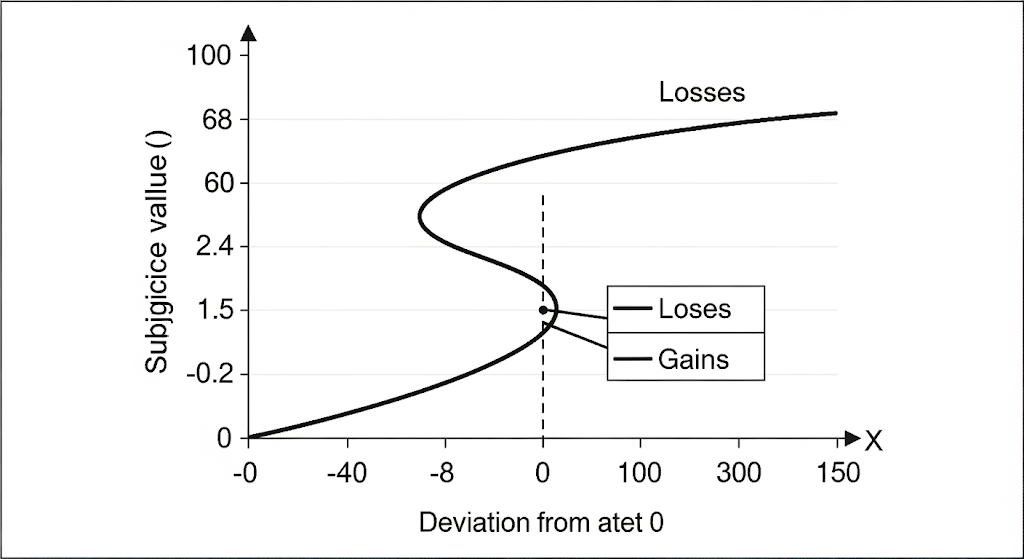
The psychological value drawn as a graph forms a unique S-shaped value function, the ‘graph of fate.’ This graph holds two important secrets about the emotions in our wallets.
- Feature A: The first slice of pizza tastes the best (Diminishing Sensitivity)
The curve flattens on both gain and loss sides. This means the joy of gaining 10,000 won from zero is much greater than the joy of gaining 10,000 won when you already have 1 million won. The same applies to losses. Due to this ‘diminishing sensitivity,’ we tend to avoid risk when facing gains but seek risk when facing losses.
- Feature B: The deep pain of loss (Loss Aversion)
The most powerful finding of prospect theory is here. The slope of the loss side is much steeper than the gain side at the origin. Numerous experiments show people feel the pain of losing 100,000 won about 1.5 to 2.5 times stronger than the pleasure of gaining the same amount. This explains why we prefer the status quo, fear change, and are willing to pay to avoid losses.
This ‘graph of fate’ is not a hastily made concept by economists to explain money. It applies a very old and fundamental psychological law governing all human perception to economic choices. Our brains use the same ancient hardware to process money as they do for sensing light and temperature. This is why the biases explained by prospect theory are so powerful and hard to shake off.
Chapter 2: The Magic Mirror Called Probability — How We Distort Possibilities
Just as we don’t perceive money’s value literally, we don’t accept probabilities objectively. Traditional economics assumed 50% probability is exactly half as valuable as 100%, but Kahneman and Tversky showed this is not true. Instead of objective probabilities, we use psychologically transformed ‘decision weights.’
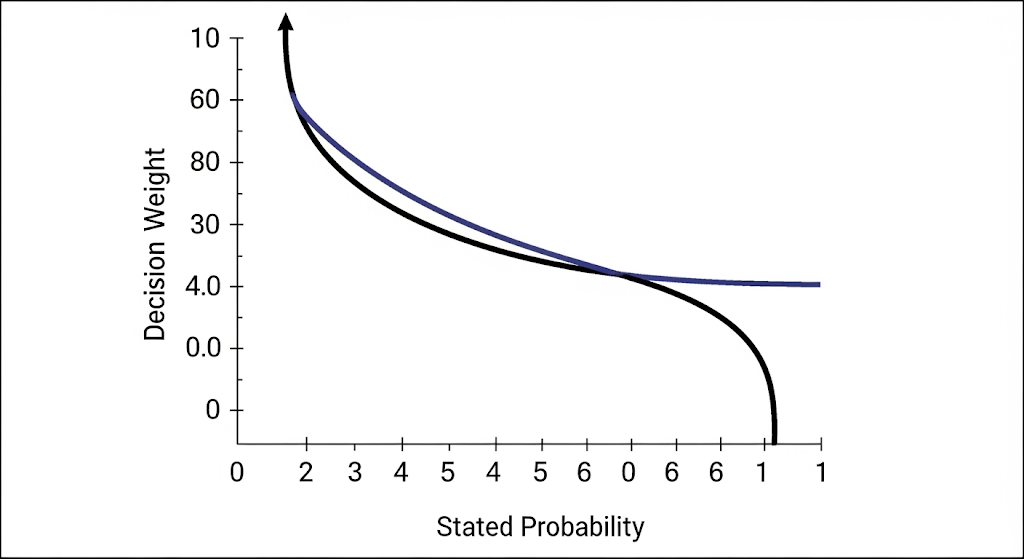
This distortion is captured by the ‘probability weighting function,’ which reflects reality like a ‘magic mirror.’ It has an inverse S-shape showing how our perception is severely distorted at the extremes of probability.
- Effect 1: The Psychology of Lottery (Overweighting Small Probabilities)
We tend to overestimate extremely low probabilities near zero. A jump from 0% to 1% feels psychologically much bigger than from 50% to 51%. This is called the ‘possibility effect.’ This explains why we buy lottery tickets with odds of 0.00001%, thinking ‘what if?’
- Effect 2: “Almost” Is Not Enough (Underweighting High Probabilities)
Conversely, we underestimate very high probabilities near 100%. The change from 99% to 100% is not just a 1% difference but a qualitative leap from uncertainty to certainty. This is the ‘certainty effect.’ It’s why a 99% survival rate still feels risky, and we pay premiums to eliminate that 1% uncertainty.
The true power of prospect theory comes from combining these two psychological distortions. First, the value function explains our ‘emotions’ about outcomes (gains/losses). Second, the probability weighting function explains our ‘perceptions’ of the likelihood of those outcomes. Only by considering both can we unlock the secrets of human behavior.
Advertisement
Chapter 3: The Ultimate Cheat Code for Predicting Human Behavior — The Fourfold Pattern
Now, let’s combine the two powerful tools we examined — the S-shaped value function (emotion) and the inverse S-shaped probability weighting function (perception). This creates the ultimate ‘cheat code’ that astonishingly predicts human attitudes toward risk: the fourfold pattern.
| High Probability | Low Probability | |
|---|---|---|
| Gains | Risk Aversion (e.g., accepting a sure settlement in a lawsuit) | Risk Seeking (e.g., buying lottery tickets) |
| Losses | Risk Seeking (e.g., gambling more to recover losses) | Risk Aversion (e.g., buying insurance) |
This table is the essence of prospect theory. Let’s examine each cell.
- High Probability Gains: Imagine a 95% chance to win 10 million won. We fear the 5% chance of getting nothing (certainty effect), so we show risk aversion by accepting a sure 9.4 million won even if it’s slightly less.
- Low Probability Gains: Imagine a 1% chance to win 10 million won. We overestimate this slim chance (possibility effect) and feel hopeful, showing risk seeking by buying lottery tickets.
- High Probability Losses: Imagine a 95% chance to lose 10 million won. Being in the loss domain, we tend to take risks. The thought ’there’s still a 5% chance’ (certainty effect) encourages risk seeking—the desperate gambling to recover losses.
- Low Probability Losses: Imagine a 1% chance to lose 10 million won. We perceive this small chance as a looming disaster (possibility effect) and, due to loss aversion, show risk aversion by paying a sure cost (insurance premium) to avoid the risk.
This fourfold pattern clearly explains why the same person can love risk when buying lottery tickets yet avoid risk by purchasing insurance — seemingly contradictory behaviors unified under one coherent framework.
Chapter 4: From Theory to Reality — Bizarre Experiments That Shook Economics
No matter how plausible a theory is, without evidence it’s empty talk. The true power of prospect theory was proven through numerous experiments predicting and explaining real-world behavior.
The Asian Disease Problem: One Word Decides 600 Lives
The most dramatic demonstration of prospect theory’s framing effect is the ‘Asian Disease Problem.’ The same scenario, when framed as a gain, leads to risk aversion, but when framed as a loss, leads to risk seeking. The only difference was the words ‘saves’ versus ‘dies,’ yet choices flipped completely. This shocking evidence showed decisions depend on subjective ‘frames,’ not objective reality.

The Secret of the Oddly Expensive Mug (Endowment Effect)
Loss aversion is not limited to money. The famous ‘mug experiment’ by Kahneman, Knetsch, and Thaler proves this. Owners priced their mugs at $7 to sell, while buyers were willing to pay only $3. This ‘endowment effect’ shows loss aversion arises simply from ownership. For buyers, the mug is a gain; for owners, selling it is a loss.
Repeated Mistakes in the Stock Market (Disposition Effect)
The real financial market is a giant lab for prospect theory. Investors tend to sell winning stocks too quickly (realizing gains) and hold losing stocks too long (avoiding realizing losses), known as the ‘disposition effect.’ This perfectly matches the fourfold pattern’s predictions.
Chapter 5: Prospect Theory in the Wild — The Force Governing Our Lives from Markets to Polling Stations
Prospect theory is not confined to scholars’ desks. It has deeply permeated our lives, quietly influencing marketing, public policy, and consumer behavior.
- Marketing and Sales: Phrases like ‘
Today only!’ and ‘Only 3 left in stock!’ create a loss frame that you’ll miss a good opportunity if you don’t act now. Also, ‘one month free trial’ cleverly instills the endowment effect in users. - Public Policy and Nudges: Governments use prospect theory to nudge people toward better choices. For example, switching organ donation consent to an opt-out system dramatically increased donation rates.
Chapter 6: Time to Read the Fine Print — Honest Confessions on Theory’s Limits and Upgrades
No great theory is perfect. Prospect theory has criticisms and limitations, and acknowledging them honestly deepens understanding.
Advertisement
- Lack of Emotion: Prospect theory is essentially a cognitive model. It does not explicitly address strong emotions like regret or disappointment after choices.
- Ambiguity of Reference Points: The reference point is the theory’s heart, but predicting which reference point an individual uses in a given situation is very difficult.
These limitations are not failures but part of healthy scientific evolution. Kahneman and Tversky listened to critiques and in 1992 released an upgraded version, Cumulative Prospect Theory (CPT), solving technical issues of the 1979 model. Thanks to mathematical refinement, CPT is a much more robust and general model. Today, ‘prospect theory’ usually refers to CPT.
Conclusion: You Are Predictably Irrational, and That Is Your Superpower
Prospect theory’s greatest legacy is shattering the myth of the perfectly rational ‘Homo Economicus’ and replacing it with a psychologically realistic human. As explored here, the core concepts of reference dependence, loss aversion, and probability distortion provide a powerful lens that consistently explains a wide range of human behaviors that traditional theories could not.
The phrase ‘graph of fate’ is not just a metaphor. That S-shaped curve maps our deep psychological responses to risk, gain, and loss. It reveals the terrain of human economic choices — predictable but not always rational.
Ultimately, prospect theory teaches us that human irrationality is not random but follows surprisingly systematic and predictable patterns. Understanding the hidden script of reference points’ pull, the pain of loss, and the lure of certainty offers not only explanations for our quirks but also a new perspective to better understand ourselves, society, and the choices shaping our lives. This is the map of our minds, and knowing the terrain is the first step to navigating it wisely.
Sources
Prospect Theory: Bridging the Gap Between Expected Utility and Prospect Theory -
Choice Theory under Uncertainty and Reservation Price Measurement Model -
Advertisement
Behavioral Economics: The Counterweight to Skyrocketing Economics -
Prospect Theory: What It Is and How It Works, With Examples -
Advertisement
More Sensitive to Loss than Gain! (Reference Dependence, Diminishing Sensitivity, Loss Aversion) -
Why People Don’t Cut Losses and Hold On: Prospect Theory in Behavioral Economics -
Explanation of Prospect Theory and Probability Weighting Function -
Behavioral Economics and Competition · Consumer Policy -
Advertisement
Utility Theory: Comparison of Utility Theory and Prospect Theory -
Prospect Theory: Developments and Applications in Marketing -
Moderators of framing effects in variations of the Asian Disease problem… -
“Exactly”: The Most Famous Framing Effect Is Robust To Precise Wording -
7 Prospect Theory-Based Marketing Strategies: Doubling Sales with Loss Aversion Psychology -
Prospect Theory: Share Gains and Combine Losses | Marketing/Sales | DBR -
Advertisement
The Essence of Investment Psychology Seen Through Prospect Theory -
Thirty Years of Prospect Theory in Economics: A Review and Assessment -
Prospect Theory: Beyond Logic: Prospect Theory and Rational Behavior -
Behavioral Economics Exploring Human Psychology | Reading the World through Economics -