
Rationality of the Efficient Market Hypothesis vs. Irrationality of Animal Spirits: What Drives the Market?
- Understand the three forms of the Efficient Market Hypothesis (EMH) and their limitations.
- Grasp the impact of the behavioral economics core concept, ‘animal spirits,’ on the market.
- See how these two theories clash in reality through the dot-com bubble and the 2008 financial crisis.
Two Perspectives on the Market: Rational or Emotional?
Attempts to understand modern financial markets boil down to a clash between two major theories. One is the Efficient Market Hypothesis (EMH), which states that all information is instantly reflected in prices. The other is behavioral economics’ concept of ‘animal spirits,’ which sees human irrational psychology as the market’s driving force.
This article compares the two theories to provide insight into why markets sometimes move unpredictably and how we should understand this volatile market.
Part 1: The Ideal Market Blueprint, Efficient Market Hypothesis (EMH)
The EMH assumes market participants are highly rational, so all publicly available information is immediately reflected in asset prices. Therefore, consistently outperforming the market average through technical analysis (analyzing past data) or fundamental analysis (analyzing company financials) is impossible.
This hypothesis is divided into three forms based on the level of information reflected in prices:
- Weak Form: Past stock prices and volume data are fully reflected in current prices.
- Semi-Strong Form: All ‘public’ information (news, corporate earnings, etc.), including past data, is reflected in prices.
- Strong Form: The strongest form, where not only public but also ‘private’ insider information is reflected in prices.
Table 1: Three Forms of the Efficient Market Hypothesis
| Type | Information Reflected | Technical Analysis | Fundamental Analysis | Insider Information |
|---|---|---|---|---|
| Weak | Past market data | No excess returns | Possible excess returns | Possible |
| Semi-Strong | All public information | No excess returns | No excess returns | Possible |
| Strong | All public and private info | No excess returns | No excess returns | Not possible |
However, market anomalies like the ‘January effect,’ where stock prices rise during specific periods, and the ‘paradox of efficiency,’ where if everyone believes the market is efficient no one analyzes information causing inefficiency, clearly show the hypothesis’s limitations.
Part 2: Behavioral Economics’ Counterattack, ‘Animal Spirits’
Behavioral economics starts from the premise that humans are not always rational. Particularly, John Maynard Keynes’s concept of ‘animal spirits’ refers to how, under uncertainty about the future, human decisions are driven by emotions like intuition or optimism rather than cold calculation.
Economists Akerlof and Shiller explained these spirits through five specific elements.
Table 2: Five Animal Spirits Driving the Market
Advertisement
| Element | Core Psychology | Market Impact |
|---|---|---|
| Confidence | Feedback loops | Formation and bursting of asset bubbles |
| Fairness | Social norms | Wage rigidity, changes in consumption patterns |
| Corruption/Malice | Trust breakdown | Financial fraud, systemic crises |
| Money Illusion | Cognitive bias | Obsession with nominal values ignoring inflation |
| Narrative/Story | Idea contagion | Speculative manias in specific industries |
For example, the powerful narrative that ‘AI will change the world’ inflates investors’ confidence, leading to rising stock prices. The rising prices then reinforce confidence in a ‘feedback loop,’ creating a bubble.
Part 3: Clash of Theories, Dot-Com Bubble and Financial Crisis
The differences between these two theories are clearly seen in historical events.
Dot-Com Bubble (1996-2001)
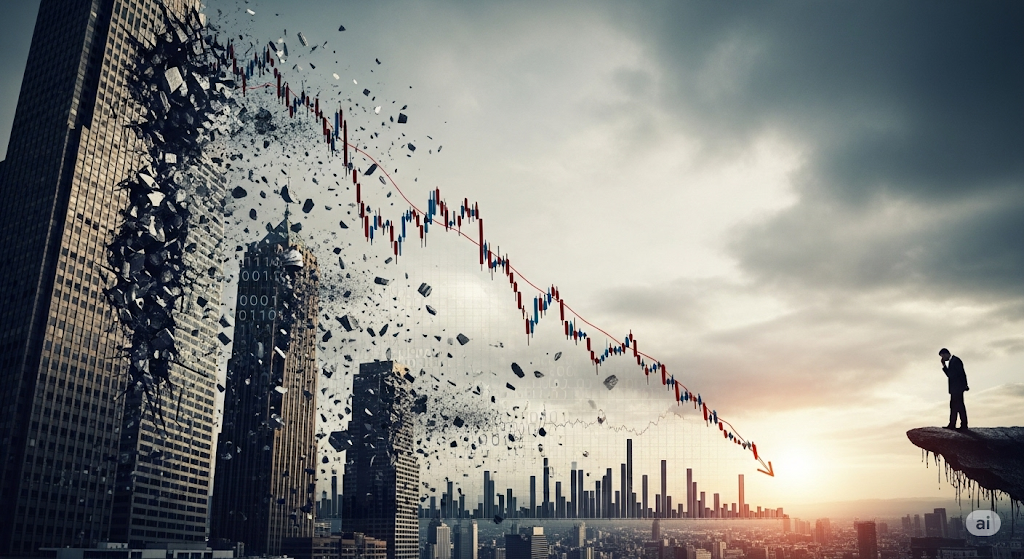
The dominant narrative was “The internet is the future.” Investors were swept up by confidence in this story and the fear of missing out (FOMO), investing irrationally at prices far above actual company values. This is a classic example of animal spirits that the EMH struggles to explain.
2008 Global Financial Crisis
The prevailing narrative was “U.S. housing prices will never fall.” This belief allowed corruption and malice such as predatory lending to go unchecked, and people fell into the money illusion, ignoring the risks of debt amid low interest rates. When the housing market myth collapsed, confidence turned to fear, triggering a global crisis of trust.
Rational Market vs. Emotional Market: Key Comparison
| Aspect | Efficient Market Hypothesis (EMH) | Behavioral Economics (Animal Spirits) |
|---|---|---|
| View of Humans | Rational and self-interested Homo economicus | Limited rationality, prone to biases |
| Information Processing | Fast and unbiased processing of all information | Reliance on psychological biases (heuristics) and emotions |
| Price Formation | ‘Unbiased’ result perfectly reflecting information | Result reflecting psychology like confidence, fear, greed |
| Market Predictability | Unpredictable (random walk) | Predictable under certain conditions due to collective psychology |
Behavioral Economics Checklist for Wise Investors
From long observation, I see the market as a complex ecosystem where rationality and irrationality coexist. How should we act in this volatile market?
- Acknowledge your biases. The moment you think “I am rational” is the most dangerous. Check if you have loss aversion or recency bias.
- Question dominant narratives. If there’s an attractive story sweeping the market, step back. Critically ask if it’s reality-based or a crowd-driven illusion.
- Maintain a margin of safety. As Benjamin Graham emphasized, buying at prices well below intrinsic value protects you from irrational market swings.
- Stick to long-term principles. Don’t get swept away by short-term noise and emotional waves; consistently follow your long-term investment philosophy.
What do you mainly attribute market movements to? Rational calculations or human madness?
Conclusion: An Integrated View of the Market
The debate between the Efficient Market Hypothesis and Behavioral Economics offers important lessons.
- EMH is a benchmark: It provides a useful ‘baseline model’ of how markets should work.
- Animal spirits are reality: Psychological factors like confidence, fear, and narratives are key drivers of bubbles and crashes.
- Markets are complex adaptive systems: They combine rationality and irrationality, sometimes coldly calculated, sometimes swept by emotion.
Ultimately, markets are human institutions embodying all human imperfections. Successful investing starts beyond sophisticated math formulas, with efforts to deeply understand human psychology.
References
- Efficient Market Hypothesis Wikipedia
- Efficient Market Hypothesis Namu Wiki
- Assumptions of Traditional Economics Hankyung sgsg
- Rational Humans and Behavioral Economics Sigma Press
- Animal Spirits Wikipedia
- Animal Spirits Nara Economy | KDI
- Narrative Economics Summary SoBrief
- Dot-Com Bubble Wikipedia
- Dot-Com Bubble Namu Wiki
- Subprime Mortgage Crisis Wikipedia