
Exploring the ancient whispers tied to clotheslines in the dark and the surprising wisdom they hold.
- Psychological, historical, and spiritual backgrounds beyond mere superstition
- The remarkable intersection of ancestral wisdom and modern science
- Practical advice for a healthy and comfortable living environment
Have you ever hesitated while looking at damp clothes hanging in the yard at dusk? The voice of your grandmother echoing in your ears, “Don’t hang laundry at night.” Is this old warning just an outdated superstition? Not at all. The taboo of hanging laundry at night passed down through generations contains practical wisdom, spiritual beliefs, and historical memories of our ancestors. This article unravels this taboo to explore the rich fabric of Korean culture.
Nighttime Visual Illusions: Military Barracks Ghosts and Pareidolia
The most primal fear behind the taboo of hanging laundry at night stems from visual illusions. In low light, our brains try to find familiar patterns, especially human shapes, from incomplete information. This is known as the phenomenon of pareidolia.
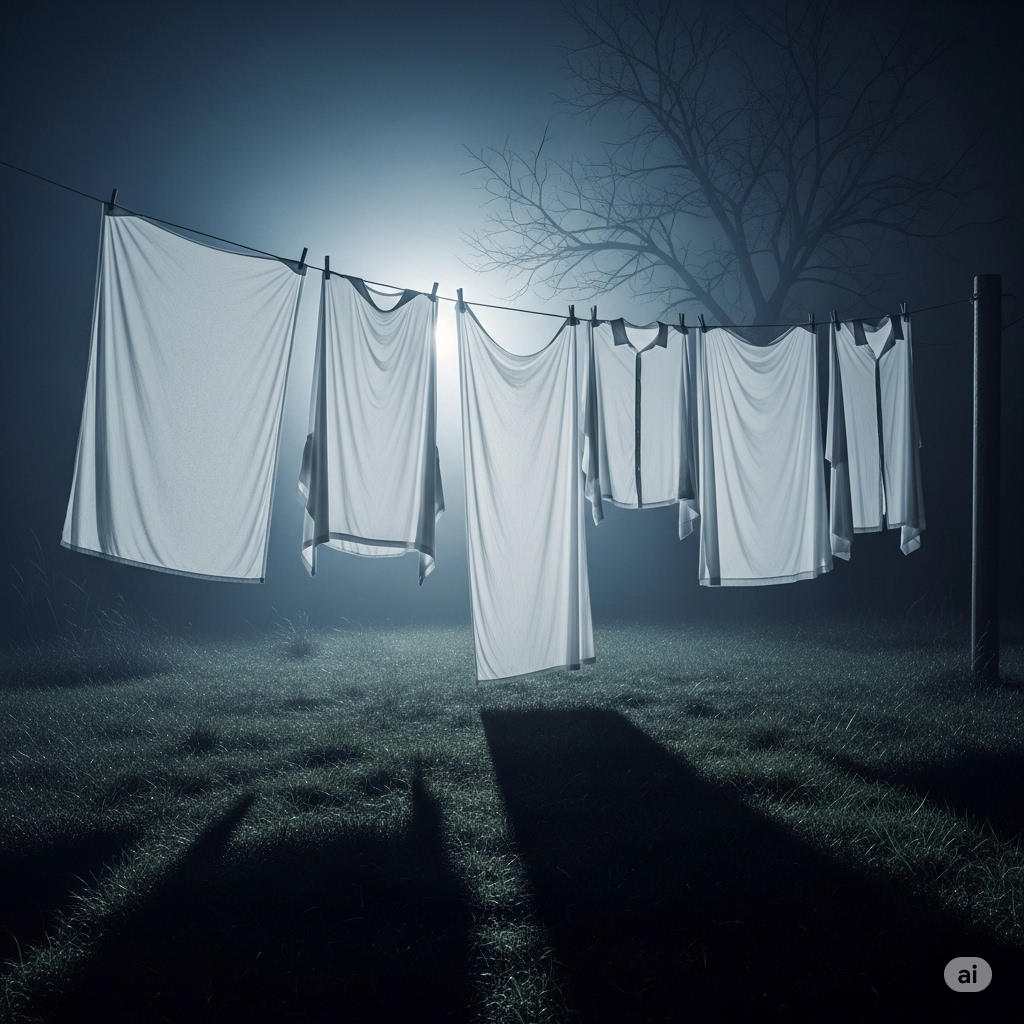
Work clothes can appear as human silhouettes in the dark.
An officer’s experience vividly illustrates this. While on patrol, he saw a swaying figure through a maintenance shop window and mistook it for a hanging person, causing a commotion in the unit. The cause was simply work clothes hanging on a rack. I also vividly remember mistaking white clothes hanging in my grandmother’s yard at night for a ghost, my heart pounding.
Such experiences extend beyond individual fear to consideration for community peace. Laundry hung at night can unintentionally startle others, so avoiding it was a practical and empathetic guideline respecting neighbors and family.
The Rules of Darkness: Traditional Korean Night and Taboos
In Korean folklore, night was not just a time without sunlight. It was a special time when the boundary between the living and the dead, and between reality and the spiritual world, blurred. Night curfews during the Joseon Dynasty and stories of the “nightlight ghost” stealing shoes reinforced the idea that night was dangerous and a time to cease activities.
The taboo against hanging laundry at night was part of this broader system of nighttime prohibitions. Like other night taboos such as whistling or cutting nails at night, it was an intricate survival strategy encoding practical wisdom in supernatural language.
Table 1: Patterns of Caution: Representative Korean Night Taboos
| Taboo | Superstitious Consequence | Cultural Interpretation (Logic) |
|---|---|---|
| Whistling at night | Summons snakes or ghosts. | Warning that sounds carry far in the quiet night, attracting unwanted beings. |
| Cutting nails at night | Mice eat them and create your doppelgänger. | Reflects fear of injury in poor lighting and the taboo against discarding body parts carelessly. |
| Hanging laundry at night | Ghosts attach or the owner’s fortune is blocked. | A complex taboo involving psychological, spiritual, and practical risks. |
The Value of Labor: The Weight of Water and Women’s History
Unlike modern washing machines, pre-modern laundry was backbreaking labor. People used lye water made from burnt rice straw ash or urine as detergent and had to beat clothes hard by the stream. Isabella Bird Bishop, who visited late Joseon Korea, noted Korean women pounding laundry all day.
Advertisement
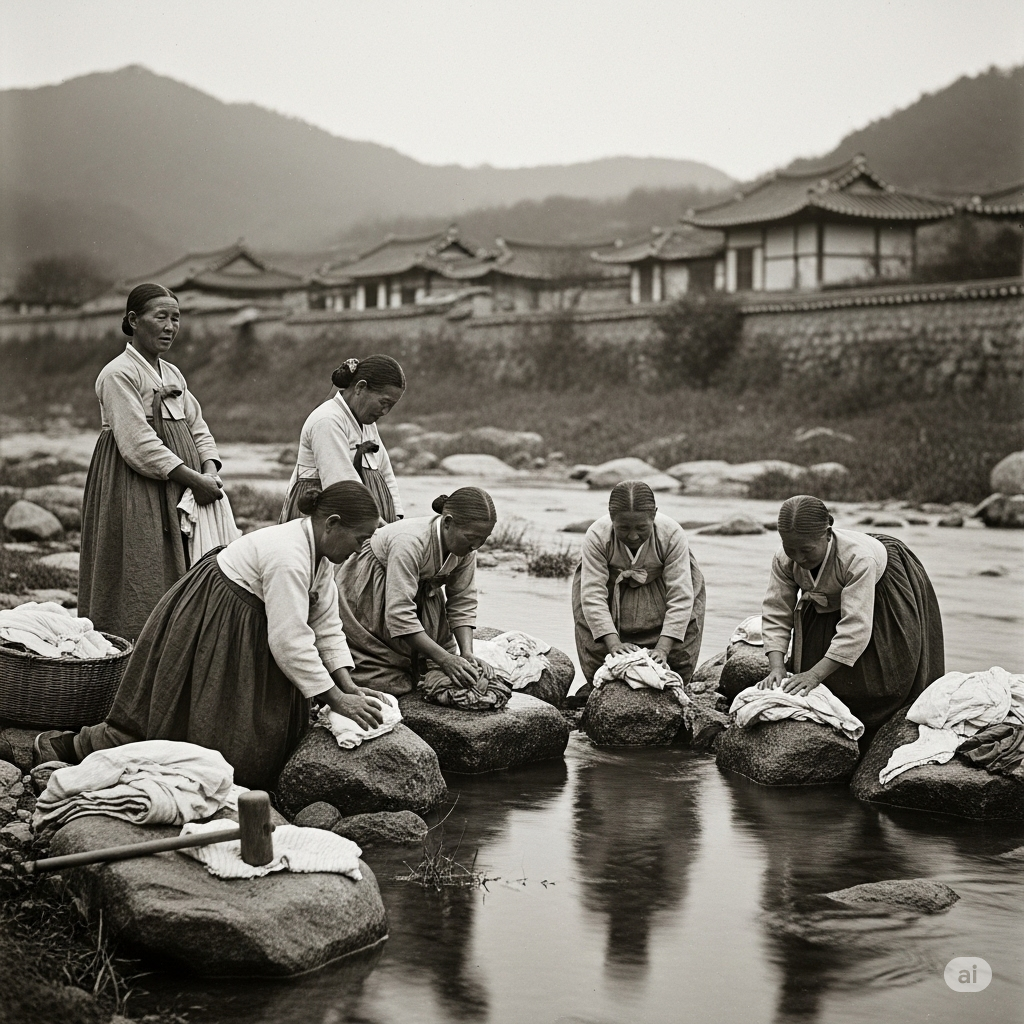
Laundry was hard labor and an important social space for women.
Leaving freshly washed clothes outside overnight was practically foolish. The cold, humid night air, especially dew, didn’t dry clothes but made them wetter, undoing a day’s effort. The saying that “the owner’s future is blocked” was not an abstract curse but a poetic warning compressing the real consequences of wasted labor, economic loss, health decline, and social disgrace.
Spiritual Pathways: Clotheslines and Invisible Guests
The taboo also extends into the spiritual realm. The superstition that “if you don’t take down the clothesline during ancestral rites, the ancestral spirits cannot enter” is significant. It implies that clothes hanging on the line can act as a ‘spiritual barrier’ blocking the path of benevolent spirits.
Extending this logic, laundry hung at night was thought to attract wandering evil spirits carrying human energy or act as a ’trap’ absorbing the negative energy (yin energy) of the night. Feng Shui also explains that damp laundry draws stagnant yin energy into the home, harming its energy.
The Science Behind the Superstition: Yin Energy and Microbes
Surprisingly, the folk warnings about yin energy and evil spirits align precisely with modern scientific principles. This proves that the superstition was an intuitive health guideline ahead of its time.
At night, temperatures drop and relative humidity rises, prolonging drying time. This damp environment is ideal for microbial growth.
- Bacterial growth: Bacteria like Micrococcus multiply exponentially in moist fabrics, causing unpleasant musty odors.
- Mold and allergies: Wet laundry increases indoor humidity, promoting mold and dust mite growth, which can worsen asthma, rhinitis, and atopic dermatitis.
- Chemical irritants: Detergent residues concentrate in poorly ventilated night air, irritating the respiratory system.

Damp laundry can become a breeding ground for bacteria and mold.
Ultimately, the folk expression that “yin energy presses on the body” described the physiological response to inhaling mold spores, bacteria, and humid air overnight. “Yin energy” was an excellent folk metaphor explaining a microbiological phenomenon. It’s like running a humidifier all night in a closed room without ventilation. Have you ever woken up feeling stiff and noticed the air was damp? The laundry hung overnight might be the cause.
Advertisement
Conclusion
The taboo “Don’t hang laundry at night” is more than a simple superstition; it is a complex cultural heritage with multiple layers of meaning.
Key Summary:
- Psychological safety net: Protects us from fear and shock caused by visual illusions in the dark.
- Community consideration: A social agreement to avoid startling others and show care for neighbors.
- Scientific health advice: Practical guidance to prevent bacterial and mold growth, reducing respiratory diseases and allergies.
Though fear of ghosts has faded today, the wisdom embedded in this taboo—respect for health, community, and the unseen world—remains valid. Why not start bringing in your laundry before sunset? It’s a small step toward a healthier and more comfortable life.
References
- Taboo (禁忌) - Encyclopedia of Korean Culture Link
- Newsletter Vol.38, National Museum of Korean Contemporary History (Bimonthly) Link
- Folk Beliefs (民間信仰) - Encyclopedia of Korean Culture Link
- [Why Did Old Women Beat Clothes with Laundry Sticks?] - Cheonji Ilbo Link
- Laundry - Namu Wiki Link
- Laundry - Encyclopedia of Korean Culture Link
- Washing (洗濯) - Encyclopedia of Korean Folklore Link
- Recommended Essay - Don’t Hang Laundry at Night / Shin Bok-hee - Korean Essayists Association Link
- “What Happens If You Hang Laundry at Night?” Fatigue Clings Overnight | Showroom - Daum Link
- Indoor Laundry Drying in Winter Can Be Harmful - SBS News Link